

Prosthetics
Built for Your Body. Designed for Your Life.
Custom prosthetic solutions crafted with precision, care, and a deep understanding of what matters most to you.
No referral required.
OUR APPROACH
Part Art, Part Science — All About You.
Living with a limb difference means navigating a world that wasn’t always designed with you in mind. At PBO Group, we believe a great prosthesis changes that — and our job is to make sure yours fits your body, your lifestyle, and your goals as precisely as possible.
Our Certified Prosthetists and Registered Technicians bring decades of combined experience to every client relationship. From your very first assessment through fitting, adjustment, and long-term follow-up, we work as a team — with you and with your healthcare providers — to get things right.
We don’t believe in off-the-shelf solutions for complex, individual needs. Every prosthetic device we provide is designed specifically for you, and manufactured right here in Ontario at our own state-of-the-art production facilities.
1. Assessment
A thorough consultation with a Certified Prosthetist to understand your needs, lifestyle goals, and physical requirements.
2. Design & Fabrication
Your device is designed and handcrafted in-house using the highest quality materials and the latest manufacturing technologies, including 3D printing.
3. Fitting & Follow-Up
We modify and refine throughout the fitting process, and continue to provide adjustments and maintenance to ensure long-term comfort and function.
Prosthetic Services
Upper & Lower Limb Solutions
We partner with the world’s leading prosthetic technology suppliers to ensure every client has access to the best available solutions.
Upper Limb Prosthetics
Custom upper limb devices designed for comfort, function, and personal expression — from functional work hands to activity-specific terminal devices. We work with leading suppliers including Ottobock, Ossur, TRS Prosthetics, Fillauer, and College Park.
Lower Limb Prosthetics
From everyday walking legs to high-activity running blades, our lower limb solutions are engineered around your movement goals. Supplier partners include Ottobock, Ossur, Trulife, College Park, Rush Foot, Freedom Innovations, Coyote Design, Willow Wood, Ortoped, and Myrdal Orthopedics.
PERSONALIZED TO YOU
Your Prosthesis Should Reflect Who You Are.
The appearance of your prosthesis is entirely your call. Some clients prefer a functional, exposed design that shows the engineering at work. Others choose a cosmetic cover with realistic synthetic skin. Others go further, working with our team to design a custom cover that reflects their personality — a pattern, an image, something that tells their story.
Beyond appearance, we build your lifestyle into the device itself. Whether your goals involve running, swimming, skating, playing hockey, fishing, or making music, we can incorporate design features that support the activities you love most.
FUNDING & FINANCIAL ASSISTANCE
We Help You Navigate the Funding Landscape.
The cost of a custom prosthesis is variable — it depends on the complexity of your needs and the device design, and can only be accurately estimated following a full assessment. We will always provide a clear cost estimate well before any work begins, so there are no surprises.
We know that cost is a real concern for many of our clients, and we take that seriously. PBO Group actively works with clients to identify and access every available funding source, including:
- Assistive Devices Program (ADP)
- Ontario Disability Support Program (ODSP)
- Rotary Club
- Lions Club
- Ontario Works
- Most major private insurance plans
Not sure what you qualify for? Our team will help you figure it out.
Frequently asked questions
Common Questions About Prosthetics
Browse our list of frequently asked questions about prosthetics.
Getting Started
How much will my prosthesis cost?
The cost of a prostheses is extremely variable. An estimate can only be provided once the device design is complete following a full assessment. However, we will always provide these estimates so that you are aware well ahead of time what the costs will be.
Will my prosthetic be covered by OHIP / Assistive Devices Program?
The Assistive Devices Program (ADP) is the Ontario Ministry of Health payer for prosthetic devices and will provide coverage for a portion of the cost but not the entire amount. PBO Group staff can provide information on additional available funding sources.
Are there organizations that provide financial support for people who need help paying for their prosthesis?
Yes, you can find more information here and PBO Group staff can help you learn more about potential financial support for your prosthesis from a variety of funding sources.
What are some common causes of amputation that you treat?
- Diabetes and vascular disease (peripheral vascular disease, neuropathy-related complications)
- Trauma (accidents, severe injury, burns, frostbite)
- Infection (including osteomyelitis)
- Cancer (bone and soft tissue tumors)
- Congenital limb deficiency
- Peripheral neuropathy
- Fibular hemimelia
About The Device
What will my prosthetic arm or leg look like when I’m wearing it?
Three different approaches can be taken regarding the appearance of your prosthetic arm or leg. In some cases, clients opt for no cosmetic cover, so the device’s inner workings can be seen. In other cases, a cosmetic cover with synthetic skin is chosen to make the device look as lifelike as possible. In other cases, a limb-shaped cover is designed with a pattern or image that reflects the wearer’s personal style. We work with you to determine the approach that best meets your physical needs and personal style.
Can my prosthesis be customized to support use in recreational activities like running, swimming, skating, hockey, golf, music, fishing, hunting, etc.?
To some degree, any prosthesis can be used for a variety of activities, however, we can also incorporate design features in your prosthesis for specific recreational pursuits such as running, swimming, skating, hockey, golf, music, fishing, hunting, etc.
How heavy will my prosthesis be?
We strive to make your prosthetic as light as possible, balancing this with the need for it to be structurally sound for your weight and activity level.
Are prosthetic devices covered by a warranty?
Assuming normal usage, all custom-made devices are warrantied against defects for 6 months. Fit and function for these devices is warranted for three months after final fit, with the exception of cases of significant changes in weight.
Assuming normal usage, custom-made paediatric devices are warrantied against defects for two months. Fit and function for these devices is warranted for one month.
For soft supports, pre-made devices, shoes, costmetic elements and consumables, these are solely covered by the manufacturer’s warranty.
To learn more about our warranties for PBO Group devices, click here.
Living with your prosthesis
Can I shower with my prosthetic device / artificial limb on?
Some prostheses are made specifically to allow you to wear them in the shower (sometimes called a shower leg). In some cases, a waterproof cast cover can be used to protect the device. Generally speaking, we recommend removing the device and using a shower seat for stability.
Can I sleep wearing my prosthetic?
We don’t recommend wearing your prosthetic device while sleeping because it is good for your residual limb to have some time each day to have a break from the pressure and the humidity associated with wearing a socket.
How do I clean my prosthetic device / artificial limb?
A mild soap and water solution that you would use on your own body is the best approach for cleaning your device. Do not use harsh chemicals like window cleaner, bleach wipes, etc., as they can cause skin irritation.
What should I do if my prosthetic/artificial limb isn’t comfortable?
Contact your prosthetist. If you are experiencing skin irritation or extreme discomfort, ulcers, blisters, or skin breakdown, stop wearing the device until you can be reassessed.
What should I do about phantom pain following an amputation?
Phantom pain can be a common complaint following amputation, and there are various treatment options, including prosthetic adjustment, mirror therapy, and/or medication. Your prosthetist and/or medical team can provide guidance based on your specific situation. Phantom limb sensation is the experience of feeling the amputated limb but is not painful. This does not need to be treated and should not be confused with phantom limb pain.
AVAILABLE AT
Prosthetics Services Near You
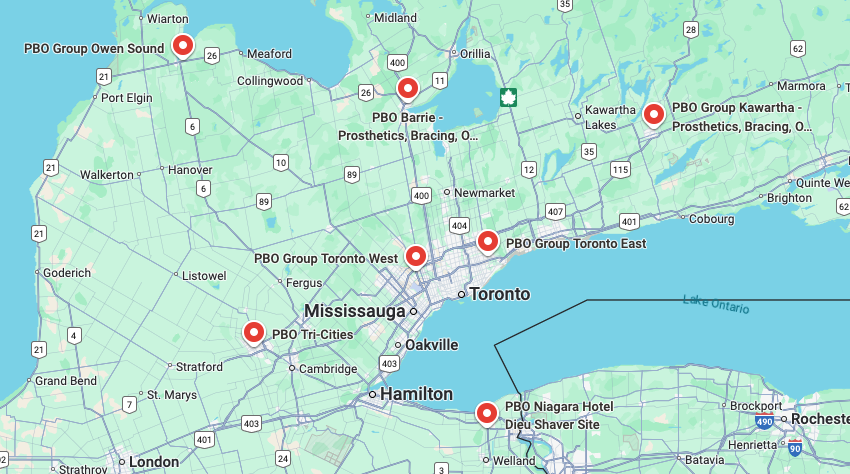
Prosthetic services are offered in:
New clients are always welcome — no referral required.