

OSSEOINTEGRATION
A New Connection. A New Chapter.
Osseointegration is changing what's possible for Canadian amputees — and PBO Group's team of Certified Prosthetists is here to guide you through every step of the journey.
Am I a candidate? Take the assessment
what is osseointegration?
Prosthetics Without a Socket.
Traditional prosthetic limbs attach to the body using a fitted socket — a carefully engineered cup that holds the residual limb in place. For many amputees, this works well. But for others, socket-based prosthetics bring ongoing challenges: friction pain, skin breakdown, perspiration, poor fit as body weight fluctuates, and a reduced sense of connection to the prosthesis.
Osseointegration is a different approach entirely. A titanium implant — called a fixture — is surgically inserted into the marrow space of the bone. Over time, the bone grows around and integrates with the implant, making it a permanent, stable part of the skeleton. An abutment is then attached to the fixture and brought through the skin, allowing the prosthetic limb to connect directly to the bone — with no socket required.
The result is a connection that is more stable, more natural, and more permanent than any socket can offer.
The difference it makes
What Osseointegration Can Mean for You.
Clients who have undergone osseointegratino surgery report meaningful improvements across many areas of daily life.
Freedom from Socket Pain
No more friction, skin breakdown, or perspiration from a socket. The implant connects directly to bone — eliminating the most common source of discomfort for socket prosthetic users.
Better Balance & Alignment
A direct bone connection improves body alignment and gives clients a more natural, stable gait and direct prostetic control.
Terrain Feedback
Osseointegrated users report a significantly improved sense of the ground beneath them — what clinicians call osseoperception — making movement more intuitive and confident.
Stronger Residual Limb
With fewer muscular restrictions, many clients see a stronger, more defined residual limb musculature over time, along with improvements in bone density.
Reduced Phantom Pain
Many osseointegration clients experience a decrease — and in some cases a complete absence — of phantom limb pain following surgery.
More steps, every day
Some single- and double-leg amputees have increased their daily step counts by 50–80% compared to pre-surgery distances.
the process
What the Osseointegration Journey Looks Like.
01 - Assessment & candidacy
The journey begins with a consultation at one of our clinics. Our Certified Prosthetists assess your situation, discuss your goals, and help you determine whether osseointegration is a realistic and appropriate option for you. Our online self-assessment is a great first step.
02 - pre-surgery support
If you proceed, PBO Group works alongside your surgical team at every stage before the procedure — ensuring coordination, preparation, and a clear plan for what comes next.
03 - Surgery
Osseointegration surgery is currently performed in Canada at Montreal General Hospital by Dr. Robert Turcotte, who performed the country’s first osseointegration procedure in 2018. It is also offered at The Ottawa Hospital led by Dr. Nancy Dudek. PBO Group maintains direct communication with these teams for integrated, seamless care.
04 - Post-Surgery Rehabilitation & Fitting
Following surgery, our Prosthetists guide you through the rehabilitation process and the fitting of your new prosthetic connection — continuing to provide adjustments, maintenance, and support as you adapt and progress.
our expertise
Proven Experience in a Specialized Field.
Osseointegration is still a relatively new field in Canada, and not all prosthetics providers have meaningful experience with it. At PBO Group, we’ve been working in this space since 2017 — longer than most.
Our team has received direct training from The Osseointegration Group of Australia, the global leaders in this procedure, and we sit on the Prosthetics Canada Osseointegration Advisory Board, shaping how the field develops nationally.
We maintain close, integrated communication with the surgical team at Montreal General Hospital — meaning your care doesn’t fall through the cracks between your prosthetist and your surgeon. We’re in it with you from assessment through recovery.
FIND OUT IF IT'S RIGHT FOR YOU
Wondering If Osseointegration Is an Option for You?
Not every amputee is a candidate for osseointegration surgery, and several factors — including bone density, residual limb length, level of amputation, and overall health — influence whether it’s a realistic path forward.
We’ve developed a short online self-assessment to help you get a clearer picture before booking a consultation.
Or book a complimentary consultation and one of our Certified Prosthetists will talk it through with you in person.
cost & funding
Understanding the Cost of Osseointegration.
The costs associated with osseointegration — covering pre-surgery assessment, the surgical procedure itself, the implant, and post-surgery rehabilitation and prosthetic fitting — vary considerably from person to person. A number of factors influence the final figure, including:
- Length of residual limb
- Level of amputation
- Prosthetic requirements
- Funding model and supplementary contributors
- Travel expenses
- Duration of rehabilitation
- Potential post-surgical complications
Osseointegration is not currently covered by OHIP or the Assistive Devices Program (ADP). However, some PBO Group clients have successfully accessed funding through their workplace health insurance benefits — while not common, it is worth exploring.
PBO Group works closely with every client to identify all available avenues of financial support. We strongly recommend booking a consultation so we can discuss your specific situation and help you understand the realistic cost range for your circumstances.
We will never leave you to figure out the financial picture alone — navigating funding is part of what we do.
Frequently asked questions
Common Questions About osseointegration
Browse our list of frequently asked questions about osseointegration or download our booklet.
Understanding Osseointegration
What is osseointegration and how does it differ from traditional prosthetics?
Osseointegration is a surgical procedure that creates a direct, permanent connection between a prosthetic limb and the skeleton — eliminating the need for a traditional socket.
In a conventional prosthesis, the residual limb sits inside a fitted socket that holds the device in place. While socket-based prosthetics work well for many amputees, they can also bring persistent challenges: friction and pressure pain, skin breakdown, sweating, and a reduced sense of connection to the prosthesis.
Osseointegration takes a fundamentally different approach. A titanium implant — called a fixture — is surgically inserted into the marrow space of the bone. Over time, the surrounding bone grows around and fuses with the implant, making it a stable, permanent part of the skeleton. An abutment is then attached to the fixture and brought through the skin, providing a secure external anchor point. The prosthetic limb connects directly to this anchor — no socket required.
The result is a more stable, more natural connection that moves with the body, transmits sensation from the ground up through the bone, and removes the most common sources of socket-related discomfort entirely.
Osseointegration is not suitable for every amputee — bone density, residual limb length, level of amputation, and overall health are all factors in determining candidacy. If you’re curious whether it might be an option for you, our online self-assessment is a good place to start, or you’re welcome to book a complimentary consultation with one of our Certified Prosthetists.
Can osseointegration be performed on arms as well as legs?
Yes, while it’s not happening in Canada yet, osseointegration is being performed on arms in other parts of the world.
Where is Osseointegration surgery currently available?
Until 2018, Canadian amputees had to travel to hospitals in Australia and Europe in order to undergo Osseointegration surgery. Currently in Canada, there are 2 locations available to receive the surgery: The Ottawa Hospital and the Montreal General Hospital.
Am I a candidate?
How do I know if I would be a good candidate for osseointegration?
Our online assessment Is Osseointegration Right For You can help you determine if you might be a good candidate.
How should I proceed if I’m interested in osseointegration, but my current prosthetist doesn’t know anything about it?
Contact us for a complimentary assessment, and we will assist you with determining the right next steps.
Risks & Considerations
Are there risks associated with Osseointegration surgery?
As with most major medical procedures, Osseointegration surgery does carry potential risks. As the amputee’s implant protrudes through the skin to connect directly to the prosthesis, it is possible for bacteria to track up the metal implant to the femur. Diligent skincare at the exit point of the implant is critical in order to prevent potential skin complications and infection.
Low bone density can also lead to other complications if the bone is not strong enough to withstand a significant increase in force following the surgery. Potential risks related to low bone density include bone fracture at the top of the implant, splitting of the bone at the implant or lack of bone integration with the implant.
Thorough testing and assessment by the highly qualified osseointegration teams in Montreal and Ottawa will minimize risk by only selecting appropriate osseointegration surgical candidates.
Cost & Coverage
How much does getting an Osseointegrated prosthetic implant cost?
From our experiences with Ontario Osseointegration candidates, we have seen costs for services related to pre-surgery, surgery and post-surgery care be quite variable and cover a very dramatic range. Like most medical procedures, there are a variety of factors that can influence cost. Some of the factors that can impact the costs associated with Osseointegration include:
- Length of residual limb
- Level of amputation
- Prosthetic requirements
- Funding model and supplementary contributors
- Travel expenses
- Duration of rehabilitation
- Potential post-surgical complications
As a result, we strongly recommend connecting with a Prosthetist at one of our locations to better understand your exact situation and determine a range of costs that will be narrower and more accurate.
Are osseointegration surgery and related devices covered by OHIP / Assistive Devices Program?
No, costs associated with osseointegration are not covered by OHIP / ADP at this time.
Will my workplace health insurance benefits cover osseointegration surgery and related devices?
While not common at this point in time, we do have some PBO clients who have received funding for the surgery/device through their workplace health insurance benefits.
PBO Group's Experience
How much experience does the PBO Group team have in providing osseointegration support to Ontario amputees?
As of 2022, the PBO Group team has provided pre- and post-surgery support to 12 amputees who have already undergone osseointegration. We have been engaged in osseointegration since 2017 and continue to update our practices and procedures with respect to delivering professional care for our OI clients.
AVAILABLE AT
osseointegration Services Near You
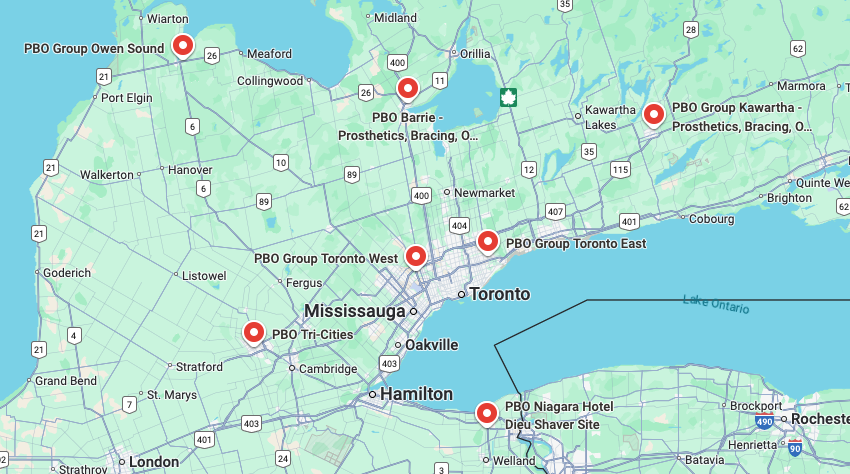
Osseointegration consultation and support services are offered at:
New clients are always welcome — no referral required.